Everything you actually need to know about the most misunderstood number in men's health — what it means, when it matters, and what the biggest testosterone trial ever run really found. No jargon, no hype.
Somewhere right now, a bloke is staring at a blood test result. Total testosterone: 11 nmol/L. The lab range says 8–29. His mate on Instagram says anything under 20 is "suboptimal." A clinic ad says he might have "low T" and should book a consult today.
He has no idea what to believe. Fair enough — because most of what he's been told is either half the story or flat-out marketing.
Here's the distinction almost nobody makes, and it's the spine of everything that follows: testosterone deficiency is not the same thing as having a testosterone level lower than you'd prefer. A man can have a low-ish number and no clinically meaningful deficiency. He can have symptoms driven by something else entirely. He can have a low number for a reversible reason that a prescription would only paper over. He can have genuine hypogonadism that warrants replacement. Or he can have a perfectly normal number and a real problem that deserves investigating properly. Five different men, five different answers — and only one blood test between them.
So let's do this properly. One article, the whole picture: what testosterone numbers actually mean, how a real diagnosis works, why your natural production shuts down on treatment, and what the largest randomised trial in history found when it finally put testosterone therapy under the microscope. No hype, no fear-mongering. Just the evidence, AU/NZ context included.
Your total testosterone number doesn't tell the whole story
Here's the first thing that trips everyone up: the number on your standard blood test — total testosterone — isn't the number your body actually feels.
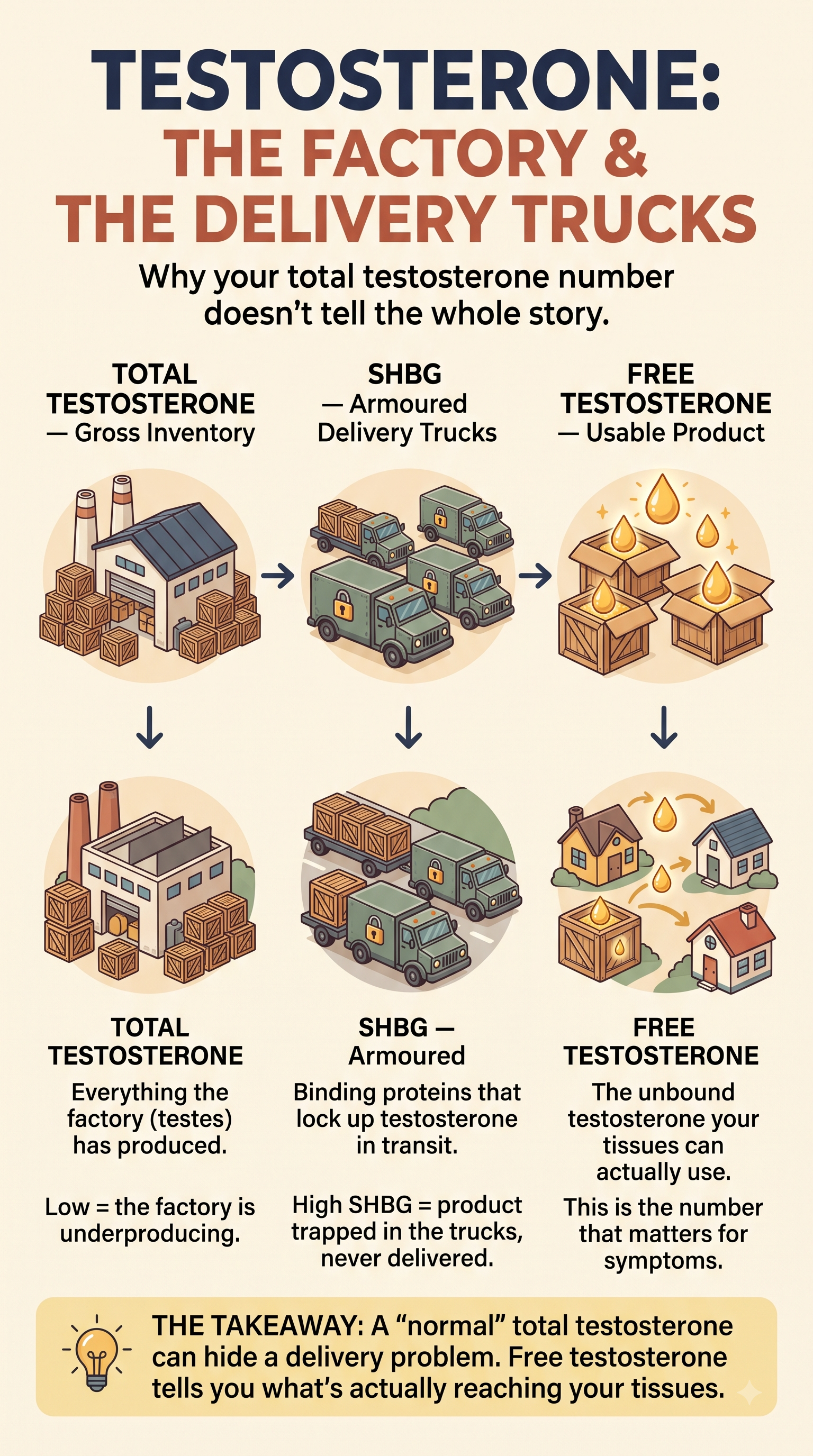
Think of it like a freight operation. Your testes are the factory. Total testosterone is everything the factory has produced — the gross inventory sitting in the warehouse and on the road. If that number is low, the factory is underproducing. Simple enough.
But not all of that testosterone reaches the customer. Around 98% of it travels bound to proteins in your blood, and the type of transport matters enormously. Roughly half rides with SHBG (sex hormone-binding globulin) — think armoured trucks, locked tight, product effectively out of circulation. The other half rides with albumin, which is more like a courier van: loosely held, easily flagged down, contents available on demand. And a small unbound fraction — free testosterone, typically 1–2% — is out on the street ready to use immediately.
Free plus albumin-bound is what clinicians call bioavailable testosterone, and that's the number that best reflects what your tissues can actually get hold of. SHBG-bound testosterone isn't useless, exactly — it's just parked.
Which means two men can have the identical total testosterone and feel completely different. If your SHBG is high — and it climbs with age, thyroid issues, and some medications — more of your product is trapped in the trucks. Normal inventory, terrible delivery. Your total looks fine on paper while your tissues are quietly running short.
The flip side matters too: SHBG drops with obesity, insulin resistance, and fatty liver. A low total testosterone in a bloke carrying extra weight can overstate the problem, because a bigger share of what he has is free and usable.
The practical takeaway: if your symptoms don't match your total testosterone, ask about SHBG and free (or calculated free) testosterone. A "normal" total can hide a delivery problem — and a "low" total can hide a perfectly adequate delivery.
What a real diagnosis actually requires
Before we go further, the fine print that every low-T clinic ad conveniently skips: a diagnosis of testosterone deficiency needs at least two low readings, from morning, fasting blood tests — plus symptoms that fit.
Why morning? Testosterone peaks early and slides through the day — an afternoon sample can read substantially lower than your true baseline, with the effect most pronounced in younger men. Why fasting? Eating, particularly a glucose load, temporarily suppresses testosterone; it's the standard used in the major trials and guidelines. Why twice? Because levels bounce around day to day, and a decent proportion of men with one low reading are normal on repeat.
And why symptoms? Because a number without a clinical picture is just a number. The symptoms that actually correlate with low testosterone are the sexual ones — low libido, fewer morning erections, erectile difficulties — plus loss of body hair, shrinking testes, hot flushes, and low bone density. Fatigue and low mood can be part of it, but they're the least specific symptoms in medicine. Poor sleep, stress, depression, and a hundred other things produce them too.
One low number on a Tuesday afternoon after lunch is not a diagnosis. It's a reason to test properly.
Where did the signal fail? The one test that changes everything
Say you've done it properly — two fasting morning tests, both low, symptoms that fit. Now comes the question almost nobody asks, and it's the most important one: why?
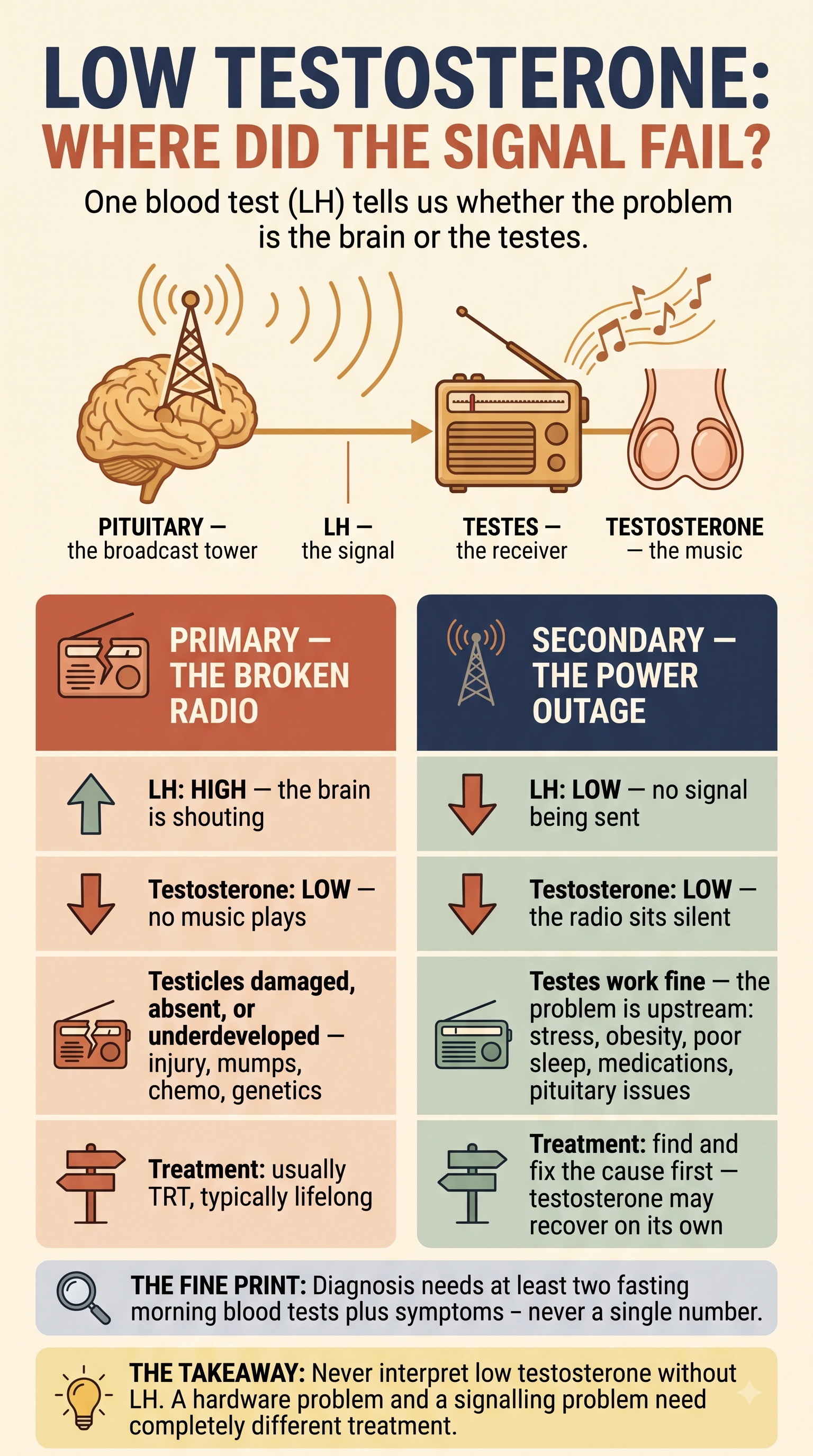
Testosterone production works like a radio broadcast. Your pituitary gland — a pea-sized structure at the base of your brain — is the broadcast tower. It sends out a signal called LH (luteinising hormone). Your testes are the receiver. When the signal arrives, the testes play the music: testosterone.
So when testosterone is low, there are two fundamentally different failure modes, and one blood test — LH — tells you which one you've got.
Primary hypogonadism — the broken radio. LH is high, testosterone is low. The tower is broadcasting at full volume — shouting, in fact — but the receiver can't respond. The problem is the testicles themselves: injury, mumps as a kid, chemotherapy, undescended testes, or genetic conditions like Klinefelter syndrome. The hardware is damaged. Treatment is usually testosterone replacement, typically for life.
Secondary hypogonadism — the power outage. LH is low or inappropriately normal, testosterone is low. The receiver works fine — no signal is arriving. The problem is upstream, in the brain. And here's the part that should make you sit up: the most common causes of a weak signal are things you can influence. Obesity. Chronic sleep deprivation and sleep apnoea. Heavy drinking. Opioid painkillers. Anabolic steroid use (past or present). Uncontrolled diabetes. Severe stress. Occasionally, a pituitary problem that needs proper investigation.
The treatment for secondary hypogonadism often isn't testosterone at all — it's finding and fixing the cause. Lose meaningful weight, treat the sleep apnoea, come off the opioids, and testosterone often improves substantially — sometimes back into the normal range entirely. Not guaranteed, and not fast. But when it works: no prescription, no lifelong commitment, no side effects.
One honest caveat on the radio metaphor: LH isn't always a clean high-or-low verdict. In obesity-related hypogonadism — the commonest pattern in general practice — LH is frequently inappropriately normal, which is its own kind of answer: the tower should be shouting given how low testosterone is, and it isn't. Interpreting that takes clinical judgement, not a cutoff.
This is why you should never accept a testosterone diagnosis — or a testosterone script — without an LH result. A hardware problem and a signalling problem look identical on a total testosterone test and need completely different treatment. Any clinic that skips this step is selling you a product, not practising medicine.
The pre-flight check: fix these first
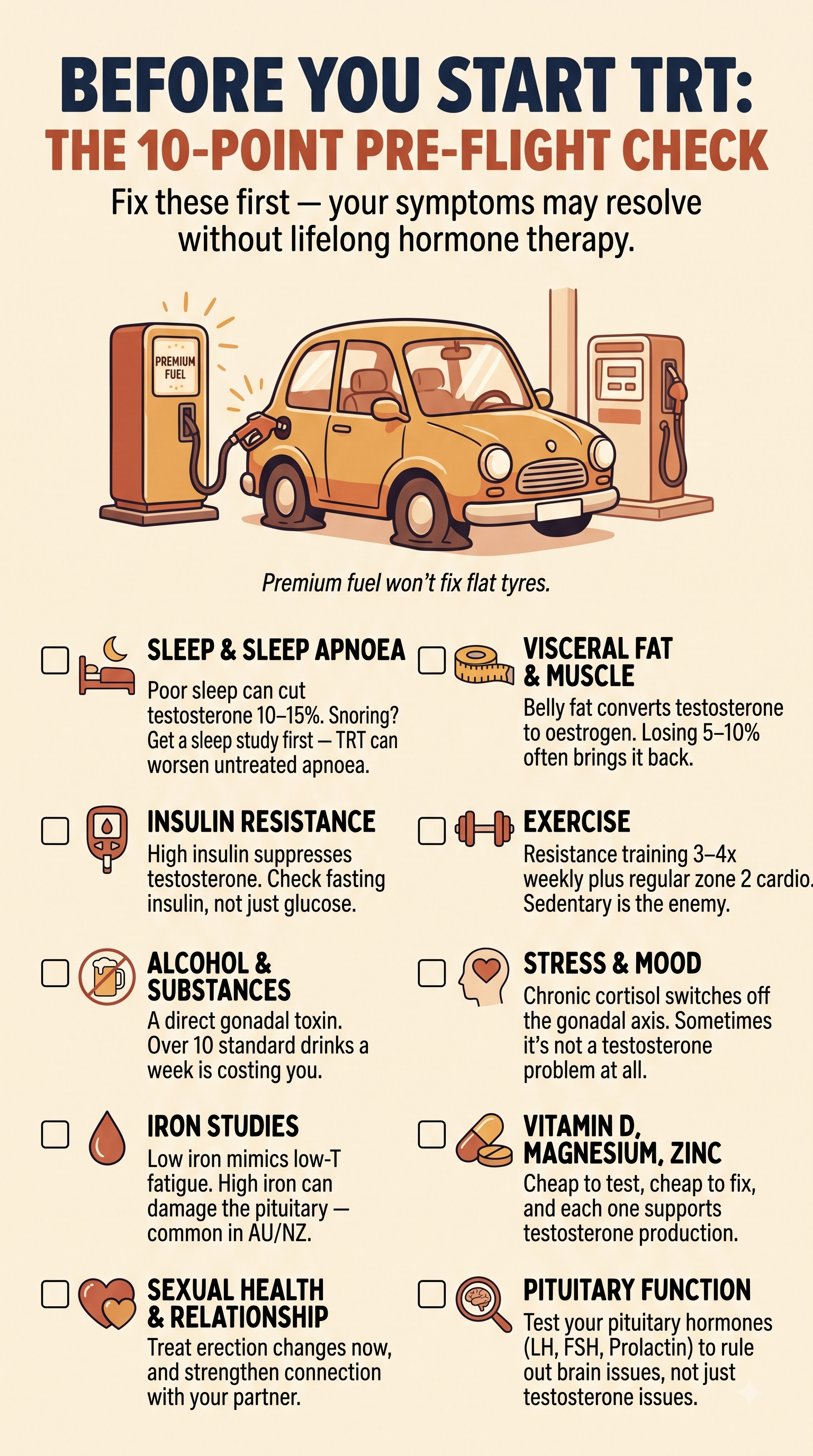
Premium fuel won't fix flat tyres. Before anyone commits you to a lifelong hormone therapy, there's a checklist of things that suppress testosterone — or perfectly mimic its symptoms — and every one of them is worth ruling out first.
The big four are the usual suspects from the power-outage list: sleep (a single week of short nights can cut testosterone 10–15%, and snoring warrants a sleep study before TRT, which can worsen untreated apnoea), visceral fat (belly fat literally converts your testosterone to oestrogen via an enzyme called aromatase — losing 5–10% of body weight often brings levels back), insulin resistance, and alcohol north of the 10-standard-drinks-a-week guideline both countries now use.
The sneaky ones matter too. Iron cuts both ways: low iron mimics low-T fatigue perfectly, while iron overload — haemochromatosis, one of the most common genetic conditions in Australians and New Zealanders of Northern European descent — quietly damages the pituitary and testes. Cheap test, big payoff. Prolactin and the other pituitary hormones rule out a brain-side cause that needs its own workup. And on vitamin D, magnesium, and zinc: correcting a genuine deficiency can help; megadosing when you're already replete does nothing except enrich the supplement industry. Test first, supplement second.
Work through this list and a decent proportion of men never need the script at all. The rest arrive at the TRT conversation with clean data and a clear conscience.
The thermostat problem: what happens when you start TRT
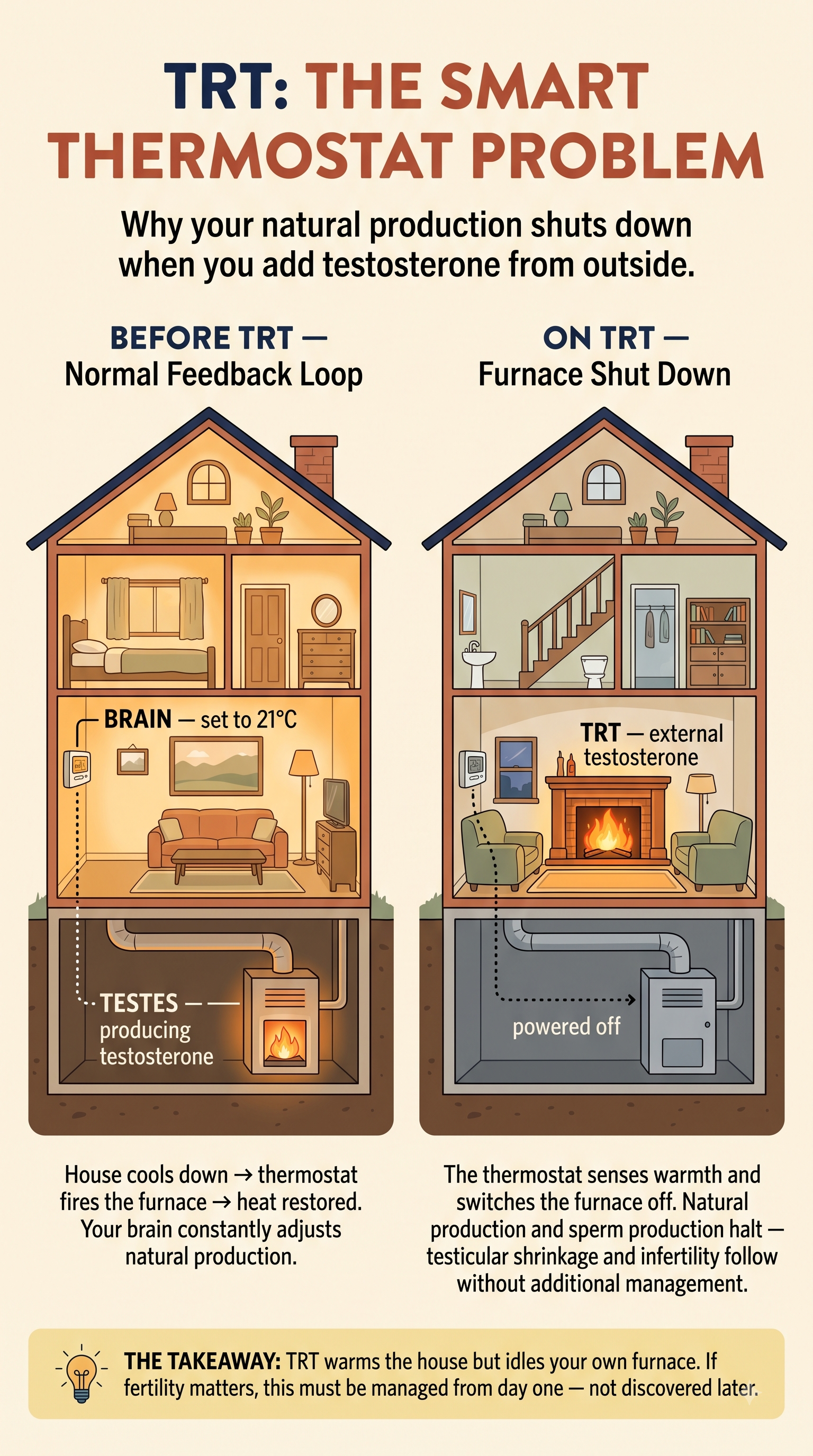
Here's the bit that surprises almost every man who starts testosterone replacement therapy: it switches off your own production. And nobody at the "men's optimisation clinic" mentioned it.
Your body regulates testosterone like a smart thermostat runs your heating. The brain is the thermostat, set to hold a steady level. When testosterone dips, the thermostat fires up the furnace — your testes — via that LH signal. Level restored, furnace eases off. It's an elegant feedback loop that's been adjusting itself every hour of your adult life.
Now bring in TRT — external testosterone, whether it's a gel, cream, or injection. As far as your thermostat is concerned, you've lit a roaring fireplace in the lounge. The house is warm. So it does exactly what a thermostat should: it shuts the furnace down. In most men on replacement doses, LH falls to near-undetectable levels — how completely depends on the dose and the formulation. Your testes wind down testosterone production — and, critically, they stop producing sperm, because sperm production depends on the sky-high local testosterone concentrations inside the testes that only your own furnace can generate. No fireplace, however warm, reaches the basement.
The consequences are predictable and real: testicular shrinkage, and infertility that develops over months on treatment. Sperm production usually recovers after stopping — but recovery can take six months to two years, and in a minority of men it's incomplete.
If there's any chance you want kids — now or in five years — this must be part of the conversation before the first dose, not a discovery afterwards. Options exist: sperm banking beforehand, or medications like hCG that mimic the LH signal and keep the furnace ticking over alongside TRT. But they only help if someone tells you. TRT is a treatment with genuine trade-offs, and informed consent means knowing about the furnace before you light the fireplace.
Two drugs deserve a mention here because they work with the thermostat instead of around it. hCG mimics the LH signal directly, keeping the testes switched on — used alongside TRT to help preserve fertility, or sometimes instead of it. Clomiphene blocks the oestrogen feedback the brain uses to sense "warm enough," so the thermostat keeps the furnace firing; it raises testosterone in selected men with secondary hypogonadism while preserving fertility. The honest caveats: both are off-label for this purpose in Australia and New Zealand, neither is subsidised for it, the supporting studies are considerably smaller than TRT's, and evidence they improve symptoms rather than just numbers is thinner still. Legitimate options in the right hands, for the right man — not shortcuts, and not equivalents.
What the biggest trial ever run actually found
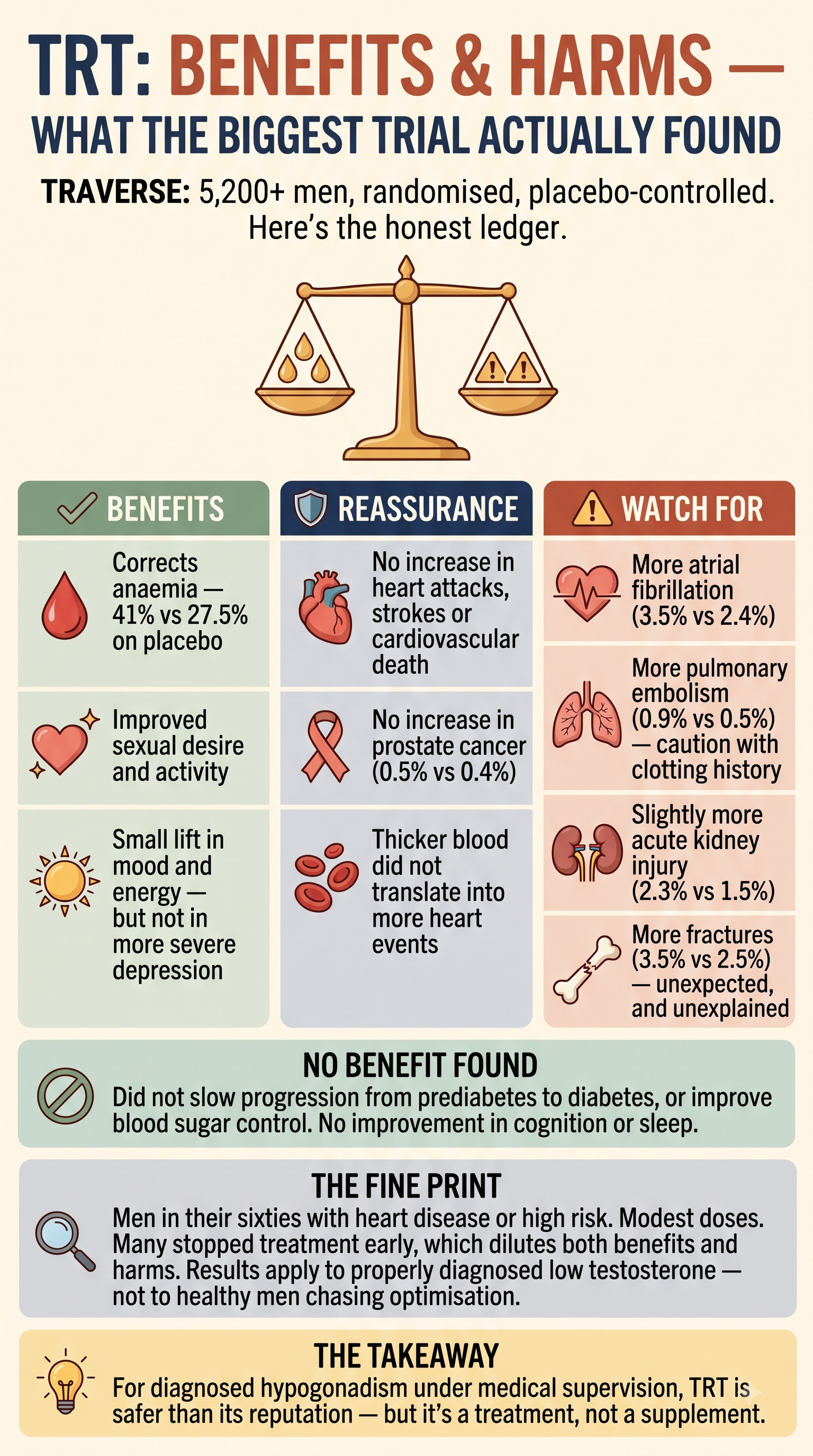
For years, the testosterone debate ran on vibes and observational data — enthusiasts pointing at cohort studies showing benefit, sceptics pointing at cohort studies showing heart attacks. Then came TRAVERSE: over 5,200 men, randomised, placebo-controlled, run because the US FDA demanded a proper answer on cardiovascular safety. It's the largest cardiovascular-safety trial of testosterone therapy ever conducted, and the best evidence we have.
Here's the honest ledger.
The headline reassurance: testosterone did not increase heart attacks, strokes, or cardiovascular death. Major cardiovascular events occurred in 7.0% of the testosterone group versus 7.3% on placebo. After a decade of scary headlines, that's a genuinely important result. Prostate cancer rates were also near-identical (0.5% vs 0.4%) — the old dogma that testosterone "feeds" prostate cancer in men without it took another hit. And although testosterone thickened the blood slightly, that didn't translate into more heart events.
The genuine benefits: anaemia corrected in 41% of anaemic men on testosterone versus 27.5% on placebo. Sexual desire and activity improved modestly. Mood and energy lifted slightly — though notably not in the men with moderate-to-severe depression, and cognition and sleep didn't budge at all. Real effects, but note the word modest. Nobody in TRAVERSE was transformed into a Marvel character.
The watch-fors: atrial fibrillation was more common on testosterone (3.5% vs 2.4%), as were pulmonary embolism (0.9% vs 0.5%) and acute kidney injury (2.3% vs 1.5%). If you've had a clot before, or you've got a history of arrhythmia, this materially changes your risk calculus.
And the trial's genuine puzzle: more fractures in the testosterone group — 3.5% versus 2.5%. That was not what anyone expected. Testosterone reliably increases bone density; that's well established from earlier trials, and it's why the researchers went in predicting fewer breaks. They found the opposite, and they were refreshingly candid that the trial hadn't been designed to explain it. Notably, the fragility-type fractures that matter most for osteoporosis didn't rise significantly — the excess was in fractures overall. Nobody knows why yet. Anyone who tells you they do is guessing.
Worth pausing on that, because it's the whole article in miniature: a treatment can improve the thing you can measure (bone density) and still not deliver the outcome you actually care about (not breaking a bone). Numbers are not outcomes.
The fine print that changes everything: TRAVERSE studied men in their sixties with heart disease or high cardiovascular risk, with properly diagnosed low testosterone, on modest doses, carefully monitored. A large proportion stopped using the gel before the trial ended — which dilutes both the benefits and the harms it measured, and is worth holding in mind before treating any single number as settled. It tells us that treatment of diagnosed deficiency under medical supervision is safer than its reputation. It tells us nothing about healthy 38-year-olds running supraphysiological doses from an online clinic chasing "optimisation." Those are different questions, and TRAVERSE didn't answer them.
One more evidence-honesty note, because we don't do wishful thinking here: the TRAVERSE diabetes substudy found testosterone did not slow progression from prediabetes to diabetes, and didn't improve blood sugar control. If you're hoping TRT will fix your metabolic health, the trial says it won't. That job still belongs to the unglamorous stuff — food, movement, sleep.
Getting it checked in Australia and New Zealand
If you've read this far and want your levels tested properly, here's the local reality.
The test: any GP can order it. Ask for a morning (before 10am), fasting sample — total testosterone, SHBG, and LH at minimum. If it's low, repeat it on a separate morning before anyone reaches for a script.
Australia: PBS-subsidised testosterone has the tightest criteria in the world. For men over 40 without an established pituitary or testicular disorder, subsidy requires two morning tests showing total testosterone below 6 nmol/L — or between 6 and 15 nmol/L with a clearly elevated LH — plus input from an endocrinologist, urologist, or sexual health physician. Age-related decline alone doesn't qualify. Men who fall outside these criteria can still be treated on a private (non-PBS) prescription where clinically justified, which is exactly the space many commercial TRT clinics operate in — at private prices, and with wildly variable quality of workup. The questions in this article are your quality filter: Did they test twice, fasting, in the morning? Did they check LH? Did they discuss fertility?
New Zealand: funded testosterone options exist and access runs through your GP, without Australia's specialist-gatekeeping. The same clinical standards apply regardless — two proper tests, an LH, a cause identified, fertility discussed. Geography doesn't change good medicine.
The bottom line
Testosterone is neither the fountain of youth nor a ticking cardiac time bomb. It's a hormone with a diagnosable deficiency state, a treatable set of causes — some of which fix themselves when you fix your sleep, weight, and drinking — and a therapy that's safer than its reputation when it's actually indicated.
And back to where we started: a deficiency is not the same as a number you'd rather were higher. The entire commercial low-T industry depends on you not noticing the difference.
The masterclass in one paragraph: total testosterone is inventory, free testosterone is delivery, and SHBG decides the difference. Diagnosis takes two fasting morning tests plus symptoms — never a single number. LH tells you whether the problem is hardware or signal, and the signal problems are often reversible without a script. TRT works, shuts down your own production and fertility, and demands a plan for both. And the biggest trial ever run says: for properly diagnosed deficiency under proper supervision, it's a legitimate treatment — not a supplement, not an optimisation hack, and not something to start because an ad told you your vitality needed unlocking.
Your levels, your call. But make it with the whole story.